
Calling the last half year (and probably the next few months) messy would be an understatement, but we are finally reaching the end of the deliberations on the so-called batch zero policy for ERCOT to accommodate historic demand growth from data centers, , with ERCOT presenting a rosy picture of a future where large load interconnection and transmission planning move in sync.
$6.5 billion in transmission projects endorsed through stakeholder process
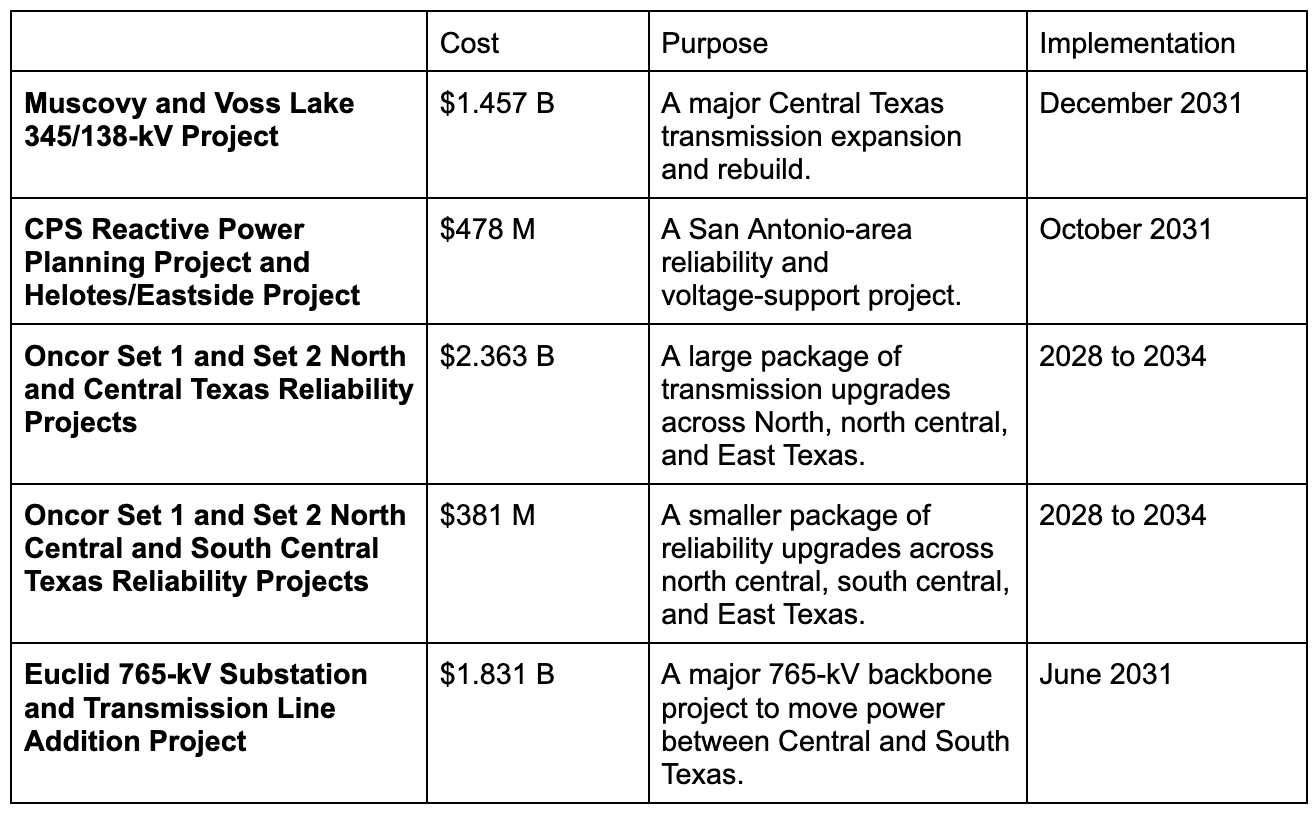
On May 19, ERCOT’s Technical Advisory Committee (TAC) endorsed approximately $6.5 billion in transmission projects across Texas on the same day it approved PGRR145, the planning guide revision request that establishes the framework for batch zero. The timing was notable. TAC members repeatedly asked how much load was embedded in the studies supporting the transmission projects and drew connections between the Regional Planning Group (RPG) projects and whether the loads studied with those projects will also be included in batch zero.
That distinction matters because the projects were presented as reliability and regional planning projects, not as direct interconnection facilities for specific large loads. However, large loads were included in several of the study assumptions, and some of those loads may not independently qualify for batch zero under the current eligibility criteria. Nevertheless, ERCOT indicated that approved transmission solutions are expected to be included in the batch zero modeling scenarios if they are approved by the ERCOT board at its June 1–2 meeting. As a result, the transmission capacity created by these projects may ultimately be allocated to a different set of large loads than the ones originally embedded in the transmission studies.
The cost-allocation discussion was appropriately left for another forum. But the TAC discussion previewed the central question that will follow these projects: will the new loads cover enough of the costs of these transmission projects to protect existing customers from rising prices? How will the PUC allocate costs in a way that is fair, protects ratepayers, and continues to support economic growth?
The future of transmission planning is comprehensive
How many loads were studied in the transmission plans? Which transmission projects will be modeled in batch zero? Will the loads studied with the transmission plans match the loads that enter into batch zero? Who will pay for the new infrastructure and how? If you haven’t been following the batch process, the TAC meeting showed how disjointed the current process is.

