
Reading and Podcast Picks is a collection of what we’ve been reading and listening to over the last week or so about energy topics.

In addition to these R&P Picks, paid subscribers receive access to the full archives, Grid Roundups, and select episodes of the Energy Capital Podcast. Please subscribe today.
Texas’ Grid Operator Prepares for More Demand Than Ever This Week | Inside Climate News
The Texas energy story this week is record-breaking demand. On Thursday, demand in ERCOT reached 91 gigawatts, shattering the 85 GW record set two years ago. But the grid operator didn’t call for blackouts or emergency conservation.
Three years ago, there was much nervousness about whether there was enough power to meet peak demand, said Michael Webber, an engineering and public affairs professor at the University of Texas at Austin. “We don’t have that same nervousness now,” he said.
Despite Texas’ population and economic growth since 2023, the state’s electricity use has yet to reach the 85.5 gigawatt peak again. It’s a sign not only of how exceptionally hot it was that summer, Webber said, but also how additional solar and battery capacity on the grid and flexibility from both generators and load have been handy tools for managing high peak demand.
Texas ERCOT Grid Holds Beyond 91 Gigawatts in Heat Wave - At What Cost? | Energy News Beat
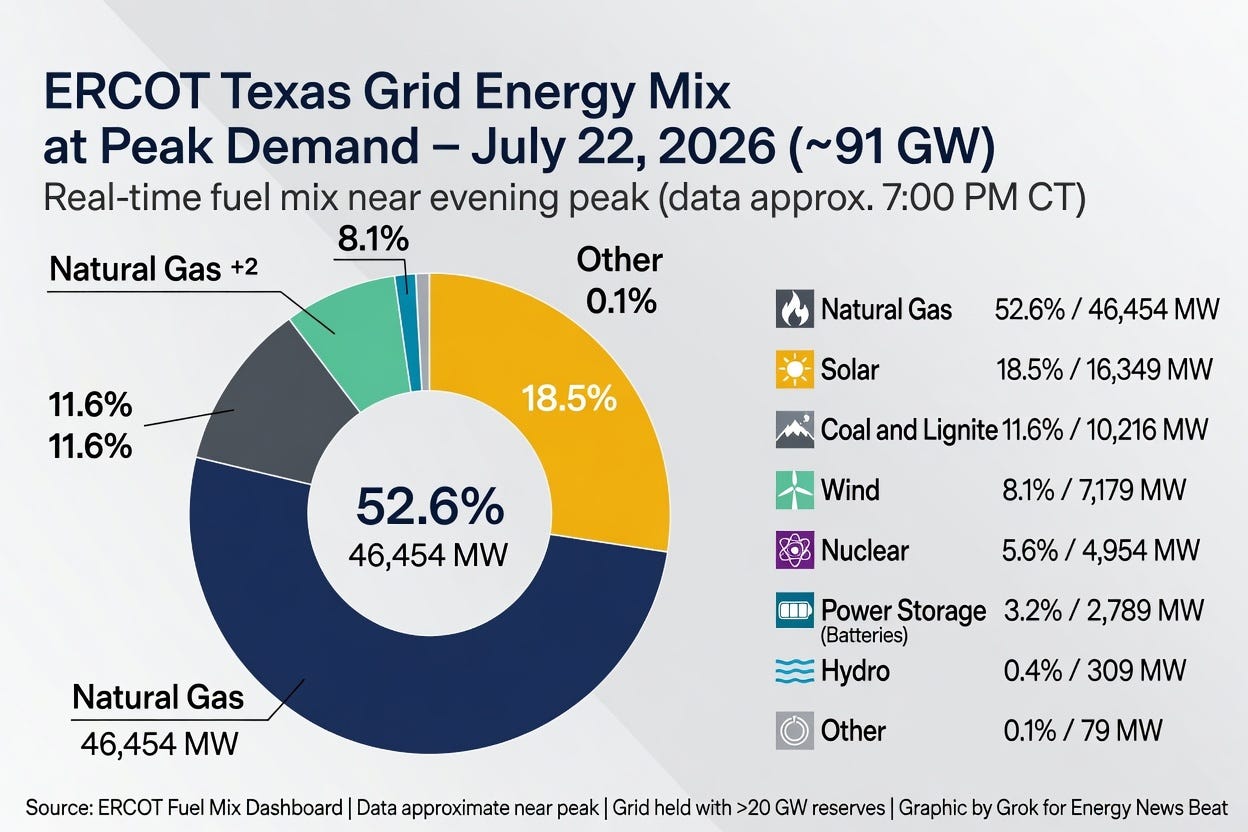
How did Texas get through the day of record peak demand? Natural gas and solar energy. See a chart from the article below the excerpt.
Natural gas remained the largest single contributor, reflecting its role as the flexible backbone. Solar contributed strongly during daylight hours (often 35–45% of generation earlier in the heat wave and rivaling or exceeding gas at times), while wind and storage filled gaps. By the end of 2026, ERCOT projects more than 45 GW of solar and 27 GW of storage capacity, a sharp increase from ~20 GW solar and 5 GW storage in 2023.
Tom Moerenhout and Tomasz Nadrowski on Fixing the Mineral Supply Chain | Columbia Energy Exchange
As the U.S. attempts to break China’s stronghold on critical minerals, scholars discuss how to develop a critical mineral mining industry in Columbia University’s Center on Global Energy Policy weekly podcast.
Basically the core problem is that governments tend to reach for sort of the same handful of tools regardless of what’s actually blocking investment. So that can be broad subsidy programs, undifferentiated funds, tax incentives and so forth. The problem right now that we have is that we’re spending public money without actually having first identified and treated, if you wish, the binding constraint on why private capital is not flowing.
