
Reading and Podcast Picks is a collection of what we’ve been reading and listening to over the last week or so about energy topics.

In addition to these R&P Picks, paid subscribers receive access to the full archives, Grid Roundups, and select episodes of the Energy Capital Podcast. Please become a subscriber today.
How blue California and red Texas became green powerhouses | Yale Climate Connections
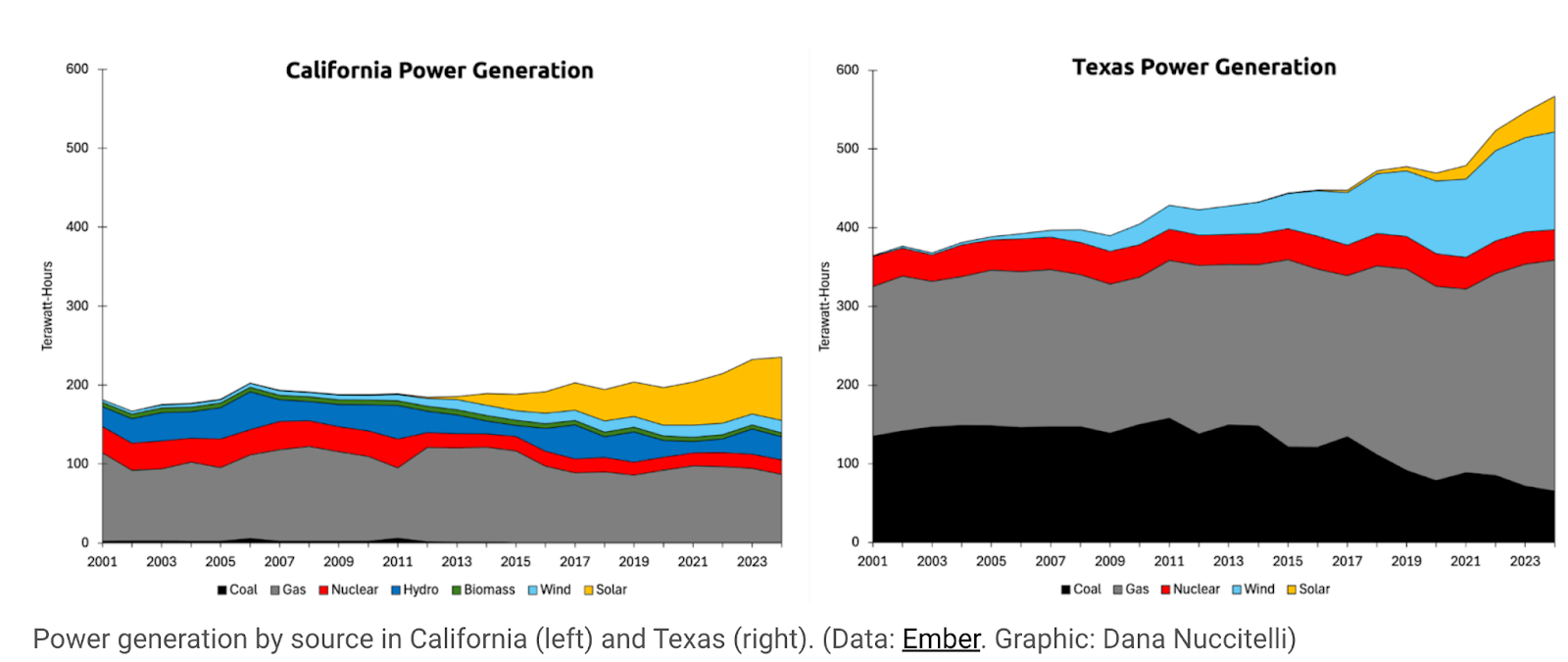
There’s been a rush of news in recent days about the staggering growth of renewables on the ERCOT grid. Just this weekend, as Texas Public Radio noted, Texas set a new record for solar power, “generating more than 33 gigawatts of electricity for the first time.” And Inside Climate News reported this month that the state “has passed California to become the leader in utility-scale solar.”
The Texas-vs.-California comparison is irresistible. Last week, Yale Climate Connections laid out why Texas’s competitive energy market has driven so much renewables growth compared to California (it also noted that power bills in California tend to be lower, thanks in part to that state’s active efficiency program, which reduces energy spending and protects the grid):
Rather than halt the growth of renewables, the expansion of natural gas in Texas came at the expense of coal. And all of the growth in electricity generation in both states over the past 15 years has been met by solar panels and wind turbines.
Simple dollars and cents continue to propel the expansion of renewable energy in the two states.
“The economics of solar and energy storage as new resources drive them to the top” in California’s state power purchases, said Brendan Pierpont, Director of Electricity at Energy Innovation, in an email. And in Texas’s free market system, “wind, solar, and energy storage are leading the way because they’re winners economically,” there as well, he added.
The biggest difference is that Texas uses a lot more energy, including more total clean energy, despite having a smaller population than efficiency-minded California.
The U.S. Energy Information Administration recently forecast that the U.S. will install a record-shattering amount of new power capacity in 2026, with solar panels and battery storage accounting for nearly 80% of those additions. Texas is expected to install 40% of that new solar capacity and 53% of the batteries, with California accounting for a further 6% and 14% of each, respectively.
Texas utility customers brace for soaring electric bills | E&E News
While Texas renewables have lowered electricity costs, especially compared with other parts of the country, bills have been rising due to increasing infrastructure spending. In a story this morning, E&E News showed how affordable solar, wind power, and battery storage have become even more important for Texas consumers as spending on poles, wires, and other needed infrastructure keeps going up:
The rise in rates is mostly thanks to a jump in transmission and distribution costs — expenses tied to building out power poles and wires that are levied by utilities across the state. While customers in other states are seeing rising rates tied to inflation and data center growth, Texas has been saddled with additional costs.
After the 2021 winter storm known as Uri, state lawmakers mandated that electric utilities upgrade their systems to be better prepared for future storms. Utilities in storm-battered regions are charging ratepayers to help cover recovery costs.
Texas’ population grew by more than 2.5 million people from April 2020 through July 2025. And now, a growing number of data centers are seeking to plug into the grid.
A study by the Texas Energy Poverty Research Institute found that the average residential electricity price rose by 30 percent from 2020 through 2025 within the region managed by the Electric Reliability Council of Texas. And the institute’s researchers forecast it could rise by another 29 percent by 2030. ERCOT, which manages the grid that handles about 90 percent of the state’s electricity demand, is largely isolated from other states.
With AI demand surging, Texas can’t stand in the way of renewables | Dallas Morning News
Texas’s nation-leading renewable resources continually face anti-energy attacks from interests seeking to undercut the industry. With the next Texas legislative session less than 10 months away, leaders who support renewables, the grid, and the Texas economy are already bracing for attacks. In an editorial this month, the Dallas Morning News editorial board warned about the implications if those attacks succeed:
Texas is already the nation’s top wind power producer and is poised to expand solar energy and industrial battery storage this year.
But as the state grapples with increased energy demands due to population growth and the influx of large users like crypto mines and massive data centers used to power artificial intelligence, lawmakers must remain open to renewable energy.
If they don’t, Texas risks falling behind in the energy race. Texans should not find themselves short on electricity because the grid can’t keep up with demand, whether that demand comes from industry, new residents or millions of people asking chatbots to generate images and answer silly questions.
Texas will continue to need dispatchable power sources, like natural gas, but blocking other sources of energy would be a mistake. Wind, solar and battery storage are among the fastest ways to add new electricity to the grid at a time when demand is growing rapidly. …
For years, Texas has maintained a relatively hands-off approach to energy development, reflecting the state’s broader reputation for being lightly regulated. But the last legislative session introduced some bills that would have curbed renewable energy if they had passed by requiring new rules and fees on these projects. Lawmakers should be careful about adding barriers to energy development as the state wades into increased energy demanded by AI and data centers.
Texas floats plan to ease data center approvals | E&E News by POLITICO
Most of the action in Texas energy is happening in quiet deliberations at the Public Utility Commission of Texas and ERCOT. One of the big questions hanging over the spring and summer concerns the process by which data centers and other large energy users will plug into the ERCOT grid.
